
Why Ham Matters
When the cell towers are down and the internet is out, the people who can still relay messages far and wide are ham radio operators. Ham (amateur) radio is how you go from, "We can talk across the neighborhood," to "We can move messages across cities, states, or continents when the normal stuff is broken."
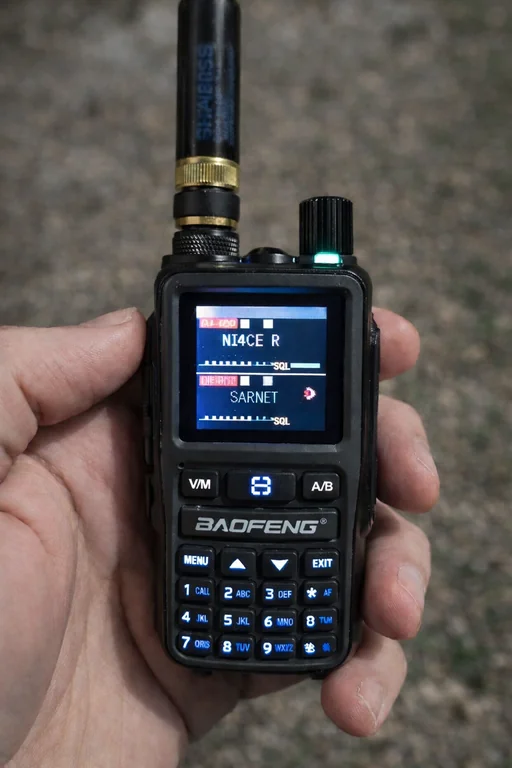
Ham radio gives you access to VHF/UHF (local & regional comms), HF (long-distance comms), digital modes, satellites, and even the ISS, all on a globally shared, non-commercial radio service.
Unlike GMRS, ham radio licenses are individual, not family-wide. And, you have to pass a multiple-choice exam. The reward is huge: more bands, more power, more flexibility, and the ability to act as a real comms backbone in an emergency.
If you're testing on or after July 1, 2026, you MUST study the NEW 2026-2030 Technician question pool. The old pool expires June 30, 2026. Studying the wrong pool wastes weeks of time. Verify which pool to study →
Why You Need at Least a Technician License
- Legal access to 2-meter (144 MHz) and 70-cm (440 MHz)
- Join local ARES/RACES emergency nets
- Talk state-wide with repeaters, nation-wide with satellites or Winlink email
- Upgrade later to General/Extra for HF (long-distance/global comms)
The 3 License Levels
| License | Exam | Questions | Pass % | New Privileges | Study Time |
|---|---|---|---|---|---|
| Technician | Element 2 | 35 | 74% | VHF/UHF, local repeaters, some HF | 3–14 days |
| General | Element 3 | 35 | 74% | HF bands (worldwide voice & digital) | +2–4 weeks |
| Extra | Element 4 | 50 | 74% | Every amateur band & more HF slices | +4–8 weeks |
You keep all privileges when you upgrade; they stack.
Quick Summary of Each Class
Entry-level license. One 35-question multiple-choice exam. You get all ham bands above 30 MHz (VHF/UHF) plus some limited HF privileges. Great for local repeaters, simplex, digital voice, APRS, and first steps into HF.
Grants much wider HF privileges. You can work most of the world, join regional nets, and properly integrate into long-haul emergency and traffic networks. This is where HF really opens up.
Highest license class. Gives you access to all US amateur bands and the most valuable HF slices. Not required for Chaos Koalas operations, but having a few Extras around is very useful.
Cost Breakdown
| Item | Typical Cost | Notes |
|---|---|---|
| Technician exam fee | $15–$35 | Paid to the VE team |
| General / Extra (same session) | Included | Most teams let you attempt higher exams for no extra fee |
| FCC license fee (10 years) | $35 | Paid online after you pass |
Am I Eligible?
In general, you're eligible if:
- You're not a representative of a foreign government
- You're able to take the exam (no age limit; kids get licensed all the time)
- You can provide basic identifying info to the FCC (for the FRN)
No background check, no security clearance, no Morse requirement. Just a multiple-choice exam on basic rules, safety, and radio concepts.
The Process: Zero to Licensed in 30 Days or Less
If you already have a GMRS license or have dealt with the FCC before, you probably already have an FRN. If not, this is how you get one.
An FRN is your FCC Registration Number. Think of it as your account ID with the FCC.
Go to the CORES Registration System
- Click "Register" (the middle box) and create an account. Use an email you'll have for the long haul.
- Log in with your new credentials.
- Select "Register FRN" from the central menu (third option down).
- Follow the prompts to register as an individual. You'll need your social security number or tax ID at this step. Submit the form.
- Your 10-digit FRN will appear at the top of the page after submission. Write it down or screenshot it.
Week 1: Technician (Most Important for Survival)
- Go to hamstudy.org (free) or download the hamStudy app (iOS/Android)
- Create account → choose "Technician 2023–2027" question pool
- Use the "Study Flashcards" mode → read explanation for every wrong answer
- When you're scoring 85%+ on practice tests consistently → schedule exam
Weeks 2–4: General + Extra (Optional but Recommended)
Same site, same method. Just add the next question pools. General gives you HF bands for worldwide communications. Extra gives you full frequency access and vanity callsigns.
Find an exam session (takes 5 minutes):
- Go to hamclub.org or use a search engine to find a ham club near you
- Book your test session
On exam day:
- Show up on time (or log in early if it's an online exam)
- Bring ID and anything the VE team requested (payment, FRN, etc.)
- Take the 35-question Technician exam
- If you pass and feel spicy, you can ask to attempt the General the same session
After you pass:
- The VE team submits your results to the FCC
- You'll get an email from the FCC about paying the $35 application fee via the CORES system
- Pay the fee online (do this from a computer if possible; the FCC site can be grumpy on phones)
- Within a day or two after payment, your new call sign should appear in the FCC database
Passing your exam doesn't mean you're licensed. Your call sign must appear in the FCC database before you can legally transmit. This usually takes 2-7 days after paying the $35 FCC fee. Why this matters →
If You Get Stuck
There are a few good lifelines if you get lost in the process:
- Your local ham radio club (search "your city amateur radio club")
- The VE team running your exam; they do this all the time
- The FCC help channels:
- Phone: 1-888-CALLFCC
- FCC Licensing Help Center
- FCC CORES Help
Or ask a Chaos Koala with a call sign. We like dragging more people into this hobby.
Ham Radio Rules (The Stuff You Can't Do)
The full legal details live in Title 47, Part 97 of the Code of Federal Regulations. Here's the short version of big "don'ts" for US ham radio:
- No broadcasting "to the general public" like a commercial radio station
- No business communications or getting paid for using your ham station
- No encrypted or secret messages (with narrow exceptions for certain control links)
- No obscene, indecent, or harassing content
- No music or entertainment programs
- No third-party traffic to certain countries without appropriate agreements
You do need to identify with your call sign regularly (at least every 10 minutes during a conversation and at the end of your last transmission on a frequency). Something simple like:
"This is KN4XYZ."
is totally fine.
After You're Licensed
Some good first moves once you have your call sign:
- Program a handheld or mobile radio with local repeaters and simplex channels. You can find local repeaters on repeaterbook.com
- Make an account on qrz.com
- Check into a local net once a week, such as the NI4CE Eagle NTS Net
- Find one practical use (weather net, storm spotting, community events, backpacking, etc.) so the skill sticks
- Decide whether you want to aim for General next for better HF access
- If you are experiencing issues, check our Gotchas section or FAQ page
- hamStudy.org Free online study platform
- Learn the NATO Phonetic Alphabet (this is not required but you'll sound so much cooler)
Getting Started: Entry-Level Handheld
Baofeng UV-5R Mini - Solid starter radio. Dual-band (2m/70cm), dirt cheap, gets you on the air immediately after you pass your Technician exam.
Buy on Amazon (affiliate link) →
Step Up: Quality Handheld
BTech UV-Pro - Bulletproof dual-band HT. Better receiver, GPS, APRS, digital scan function.
Buy on Amazon (affiliate link) →
Mobile/Base Station Rigs
Radioddity DB25-D - Dual-band mobile with 25W output. Perfect for vehicle installs or as a home base with a proper antenna. Clean interface, solid build.
Buy on Amazon (affiliate link) →
Retevis RT95 - Budget-friendly dual-band mobile (25W). Gets you on repeaters, does cross-band repeat. Good entry point for mobile operations.
Buy on Amazon (affiliate link) →
Power Supplies
Powerwerx SS-30DV - 30A regulated 13.8V DC power supply. Powers mobile rigs at home, clean output, Anderson Powerpole connectors. This is what you need for base station operation.
Buy on Amazon (affiliate link) →
Antennas
Nagoya NA-771 - Flexible whip antenna for handhelds. Better than stock, won't break off when you snag it. Simple upgrade that improves range.
Buy on Amazon (affiliate link) →
Comet CA-2X4SRNMO Dual Band Mobile Antenna - Antenna for vehicles, handles highway speeds. Get your mobile rig talking to repeaters 50+ miles out.
Buy on Amazon (affiliate link) →
License Study Materials
ARRL Ham Radio License Manual - Official study guide for Technician class. Covers theory and FCC regs. Pair this with practice exams online and you'll pass first try.
Buy on Amazon (affiliate link) →
Programming & Accessories
BTECH PC03 Programming Cable - USB programming cable for Baofeng/BTECH radios. Get CHIRP software running, program your repeaters properly instead of fat-fingering them on the keypad.
Buy on Amazon (affiliate link) →